
Whitebark pine or white pine is a species of small- to medium-sized subalpine conifers found at mid to high elevations in the mountainous regions of Canada and western United States. From small trees with broad crowns and rapidly spreading trunks to shrubs with twisted branches and widely extended crowns, the whitebarks vary in shape as they are continuously exposed to severe freezing winds.
 Mark Matzeldelaflor
Rocky Mountain Juniper

Rocky Mountain Juniper is a small- to medium-sized coniferous tree native to North America, growing at an elevation of about 500-2700 meters (1600-8900 ft) on dry soils usually with other juniper species. It has a wide, irregular crown and twisted trunk.
Western Larch

Western larch, also known as western tamarack or tamarack, is a species of large deciduous conifers found on the lower mountain slopes and valleys of western North America, as well as in parts of Canada and the United States. Although it is typically found in forests with mixed species of trees, it can sometimes grow in pure groups. It has a pyramidal form with level to upswept main branches and sagging side branches.
Japanese Black Pine

Japanese black pine, with its spreading and swaying branches, is a species of evergreen, coniferous trees native to the coastal and mountainous regions of South Korea and Japan. Being adaptable to a variety of soil conditions, these conifers are commonly used for seaside plantings and beach landscaping.
Mountain Chickadee

Mountain Chickadees are small, stockily-built passerine songbirds with short and strong beaks.
Eastern Hemlock (Canadian Hemlock)

The Eastern Hemlock stands as a living testament to nature’s endurance. With its graceful, soft needles and towering height, this majestic evergreen tree dominates forests across eastern North America. Known for its resilience, ecological importance, and cultural significance, the Eastern Hemlock continues to inspire awe, while providing shelter, food, and environmental balance in the ecosystems it inhabits.
Sitka Spruce

What is Sitka spruce?
Named after the Sitka community in Alaska, the Sitka spruce is a species of large evergreen conifers found in the western coastal regions of North America at an elevation of 400-1000 m. Being the third tallest coniferous tree species in the world, the Sitka spruce is known to reach over 90 meters in height.
Mountain Horned Lizard: Unique Reptile with Fascinating Behaviors and Adaptations

In the dense forests of Southeast Asia, the Mountain Horned Lizard is a master of disguise. With its spiny head and scales designed for camouflage, this reptile moves silently through the foliage, waiting patiently for its next meal. Known for its incredible adaptations and unique behaviors, the Mountain Horned Lizard captivates not only scientists but reptile enthusiasts around the world.
Wood Bison

The largest terrestrial mammal in North America, the wood bison is a dark brown bovine animal with a large head, a high hump on its shoulder, which is covered with long shaggy hair that extends to the front legs. The horns are short and black and tend to curve inward for the males, while being straight in females.
Northern Shrike

Northern Shrike is a species of medium- to large-sized predatory songbirds that spend the summer in the northern territories of Asia and Europe, as well as North America including Canada and Alaska, but they winter south in the temperate regions. These passerine birds are characterized by a large head, a sturdy beak that is curved at the end, and medium-long black tail with white corners.
Asian Black Bear (Moon Bear)

Asian black bear aka the white-chested bear and moon bear is a species of medium-sized bears characterized by a sturdy frame, round head, and rough coat. Although their appearance is similar to brown bears, the black Asian bears have a lighter body, slender limbs, larger nose and lips, smaller skull, and a larger jaw. Their bell-shaped ears are longer as compared to those of their relatives – the American black bear and the brown bear.
Creeping Juniper

Creeping juniper is a species of graceful, aromatic, low-growing, evergreen shrubby conifers native to the boreal and subarctic regions in North America, though some populations are also scattered further south in America. Featuring plume-like horizontal branches, the creeping junipers have blue-green foliage in both spring and summer, turning into dark purple in winter.
Limber Pine

The very durable Limber Pine is a species of high-elevation, evergreen coniferous trees typically found in the mountainous regions of the Western US, Canada, and Mexico. These trees have an initial pyramidal structure but at maturity, their crown becomes more rounded, while those limber pines growing in high alpine sites are relatively shorter with a shrubby and twisted form.
White-Nosed Coati (Coatimundi)

White-nosed Coati, also called Coatimundi, is a species of mammals belonging to the raccoon family indigenous to the southwestern North America, Central America, and South America. It has a narrow, elongated head with small, rounded ears and a pointed, flexible snout that is somewhat tilted up while its tail is furry and tapers to the tip. Its face has a dark brown or blackish gray color with white patches occurring around its ears, nose, and eyes.
American Bison

The American bison is a species of large ungulates that are not related to true buffalo species such as the African and the Asian water buffaloes. Their huge, bulky frame is emphasized by a towering hump on their shoulder while their massive head, featuring a wide forehead, a pair of up-curving horns, and straggly facial beard rests on a short, compact neck.
Engelmann Spruce

Engelmann spruce is a medium- to large-sized evergreen conifer indigenous to the western parts of North America, typically growing at high altitudes between 3,000 ft and 11,980 ft (900 m and 3,650 m). These spruce trees have a pyramidal crown with a slightly rounded top and their branches extend to the ground, giving the whole tree a low, shrubby look.
Rough-Legged Hawk

Rough-legged hawk, formerly called the rough-legged falcon, is a moderately large, migratory bird of prey that spends the summer in the Arctic as well as the Subarctic regions, moving south to avoid harsh winters. As compared to its Buteo cousins, including the ferruginous hawk and the red-tailed hawk, the rough-legged raptors can be identified by their smaller bills, broader wings with wide wingtips, and a longer tail.
Fraser Fir

Fraser fir is a coniferous tree found in the southern Appalachians in southeastern America at high altitudes between 3,900 ft to 6,683 ft. This fir species, noted for having a strong turpentine scent, exhibit a well-proportioned appearance with good needle retention ability. It has a conical crown consisting of straight twigs that are sometimes angled slightly upwards. The branches of the young trees are more compact and dense compared to those of the matured ones.
Noble Fir

Imagine standing beneath a tree so grand that its towering form seems to touch the sky. The Noble Fir is a true giant of the forest, its symmetrical branches stretching out like a living cathedral. Known for its striking blue-green needles and robust wood, this evergreen is a symbol of resilience and beauty, thriving in the rugged landscapes of the Pacific Northwest.
Woodland Caribou

Woodland caribou or the boreal woodland caribou is the largest subspecies of caribou, a group of mammals belonging to the deer family. These medium-sized ungulates, native to the Northern United States and Canada, are characterized by a compact body with a thick covering of fur, short, wide ears, blunt muzzle, and a tiny tail.
The antlers of woodland caribou are broader, thicker, as well as more compact and flattened compared to those of barren-ground caribou, while their heads and legs are also longer than the latter.
Atlas Cedar

Atlas Cedar is a species of picturesque coniferous tree found in the Atlas Mountain Range of Morocco and Algeria at an altitude of 1,370-2,200m. It has a loose pyramidal form when young, and its striking green or bluish-green foliage, along with its long branches, spread rapidly, becoming flat-topped with age. When given enough room to grow freely, it can reach up to a height of 40m, and its crown can spread up to 12m.
Iberian Lynx

Iberian lynx, the most threatened feline species in the world, is native to the Iberian Peninsula. These medium-sized cats have tufted ears, dense beard-like facial hair, a bobbed tail, and long legs akin to the other species in their genus. However, their reddish-brown or yellowish coat patterned with dark spots is shorter than most other lynxes. Some extinct populations that were native to the western regions of their geographic range had spotless coats.
Serbian Spruce

The Serbian Spruce, distinguished by its tapering form and needle-like leaves, is a species of medium-sized coniferous tree found in the mountainous regions along the Drina River valley of eastern Bosnia and western Serbia at an elevation of 2,625-5,249 ft. It has dark foliage with blue-green undersides, and its buff-brown shoots are quite hairy.
Port Orford Cedar

Port Orford Cedar, widely known for its quality of wood and horticultural uses, is a conifer native to northwest California and southwest Oregon. It is found at an elevation of 4,900 ft (1,500 m) in the valleys of Klamath River.
Concolor Fir (White Fir)

The concolor fir is a species of coniferous trees found in the western parts of North America at an altitude of 3,000-11,200 ft (900-3,400 m). Its small, needle-like leaves occurring in rows are usually flat and are without stalks. The leaves at the apex are curvier and thicker than the leaves below.
The young trees have smooth, gray, thin barks with conspicuous resin-bearing pockets. However, as they grow old, the trunks become thick, light gray or reddish-brown in color, and have deep furrows with flattened ridges.
Eurasian Lynx

The Eurasian Lynx is a species of medium-sized predatory cats found in East and Central Asia, Siberia, Scandinavia, as well as in parts of Europe. It has a strong muscular body and long, powerful legs, with the characteristic stubby “bobbed” tail having a black rounded end. The tips of its large ears have the distinguishing black tufts while its frill of long gray/white cheek hairs gives off an impression of a dense mane.
Hairy Woodpecker

The hairy woodpecker is a small- to medium-sized bird found in the high mountain forests of Central America, as well as both the plains and the mountainous regions of North America. It is a powerful bird for its size, often seen foraging along the branches and tree trunks. Though it has some striking similarities with the downy woodpecker, it has a much larger structure and its bill is longer as compared to the thornlike bill of the downy.
Emerald Tree Boa

Emerald tree boas are non-venomous snakes native to South American rainforests. They earn their name from their emerald green body while the white zigzag “lightning” stripes covering their backs help in distinguishing them from other South American snakes.
American Kestrel

The American kestrel is the smallest falcon of North America and is the only kestrel found in the Western Hemisphere. Even though it has a small body, it is a fierce predator and is usually seen waiting to pounce on its prey in the open country.

Red Breasted Nuthatch

The red-breasted nuthatch is a small songbird that gets its name from its cinnamon under parts. It lives in the coniferous forests of Canada, Alaska, and parts of the United States. This little bird usually stays in its permanent location all through the year, although it sometimes irrupts to the southern regions if there is paucity in their food supply.
Great Grey Owl

The great grey owl is recorded as one of the largest species of owls in the world, found in coniferous forests and mountainous regions in the Northern Hemisphere. These birds are endowed with a large round head and a grey face with yellow eyes encircled with dark circles. The grey feathers all over its body have given this bird its name.
Its fluffy feathers make it look very large, earning the owl its name. Even though it has a large wingspan of up to 60 inches, it is only half as heavy as a snowy owl. Adult owls have a voracious appetite for rodents and can eat large quantities of food measuring around one third of their actual body weight each day.
Brown-Headed Cowbird

The brown-headed cowbird is a small songbird that belongs to the icterid family of passerines. They are native to temperate, and subtropical North America and their range extends from Canada to Mexico. The birds living in the southern parts of North America are permanent residents. However, the birds that inhabit the northern parts of the Western Hemisphere migrate to the southern parts of the United States and Mexico during winter and return to their original dwelling places in March or April.
Western Diamondback Rattlesnake

The western diamondback rattlesnake is a poisonous serpent found in many regions of the United States of America and Mexico. In fact, a large number of deaths caused by snake bites can be attributed to this species.
Western Pond Turtle

The western pond turtle is a small to medium freshwater turtle, found in ponds and streams. This reptile is generally brown or black in color on the upper shell and yellow and black on the lower one. They are found in the western coast of the United States and Mexico. The Canadian Species at Risk Act drafted in May 2002 has identified this turtle as having become extirpated in Canada.
Least Weasel

The least weasel is the smallest species of the weasel family and is also known as only the “weasel” in the United Kingdom. It is the smallest carnivore in the world with a typical long and slender body contour. This mammal has long whiskers, big eyes, relatively short limbs and a short tail.
Meadow Vole

The meadow vole is a common North American mammal that is widely distributed across this continent. It is highly active and lives in burrows dug into the ground. In spite of the fact that they live in locations within close proximity to one another, they constantly fight with other members of the same species. They sometimes damage garden plants, fruit trees and commercial crops.
White-Breasted Nuthatch

The white-breasted nuthatch belongs to the nuthatch family that includes a number of small songbirds. It is found throughout the temperate regions of North America and breeds in the woodlands that are full of old trees.
This bird is endowed with a stocky body consisting of a big head, strong beak, small tail and powerful feet. It has a white face and has a light blue-gray hue on the upper parts of its body. Its ventral side is also white, the top of its head is black and the lower belly is tinged with a chestnut shade.
White-Throated Sparrow

The white-throated sparrow belongs to the American sparrow family and is found all over the coniferous forests of North America. They get their names from their bright white throats bordered by a dark malar stripe.
These beautiful singing birds are also called as Canadian sparrows as they are found all over Canada. They are polymorphic and come in two colors or morphs – the white-striped and the tan-striped, which makes them even more distinctive and special.
American Marten
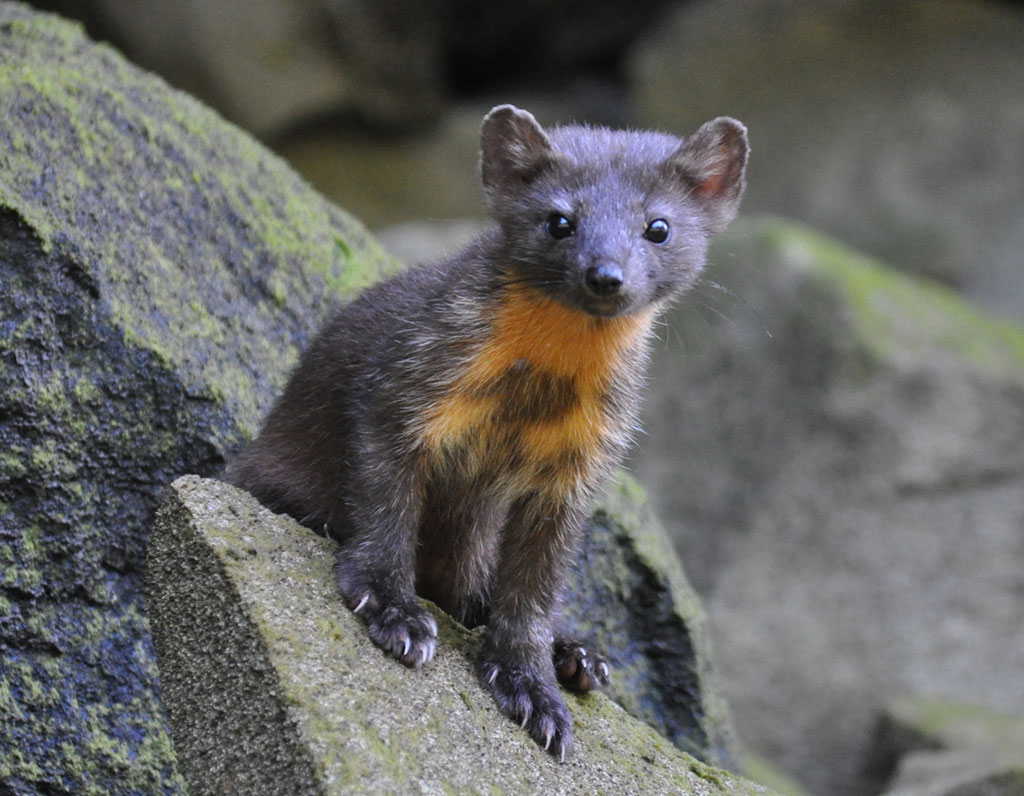
The American marten is a North American mammal of the weasel family. This predator is also known as the “pine marten”; this name is derived from the common but distinctive martens that are found all over Eurasia. It is smaller and has a lighter color than the fisher (Martes Pennanti).
This small animal has golden brown fur with a yellow chest. It has a long and slender body with large eyes. Their small rounded ears resemble those of cats and they also have sharp, curved claws.
Long-Eared Owl

The long -eared owl is a common species of owl widespread along the Northern Hemisphere. This bird is found throughout Europe and North America with some of them migrating to parts of Asia during the winter months. The so called “ears” of the long-eared owl are just tufts of feathers located above its head with the real ears of this bird actually hidden behind the feathers on its head.
Western Tanager

The western tanager is a medium-sized songbird found in the western regions of the United States. The adult male of this species has attractive orange-red and yellow plumage with an articulate voice and singing pattern similar to the American Robin. They prefer living in coniferous forests that they consider to be their natural abode.
Western Fence Lizard

The Western Fence Lizard is a reptile that is often seen scurrying along the shrubs and trees of the woods in the western states of America. They are very common in coniferous forests that form part of their natural habitat. One can also keep them as pets, but they need special care.