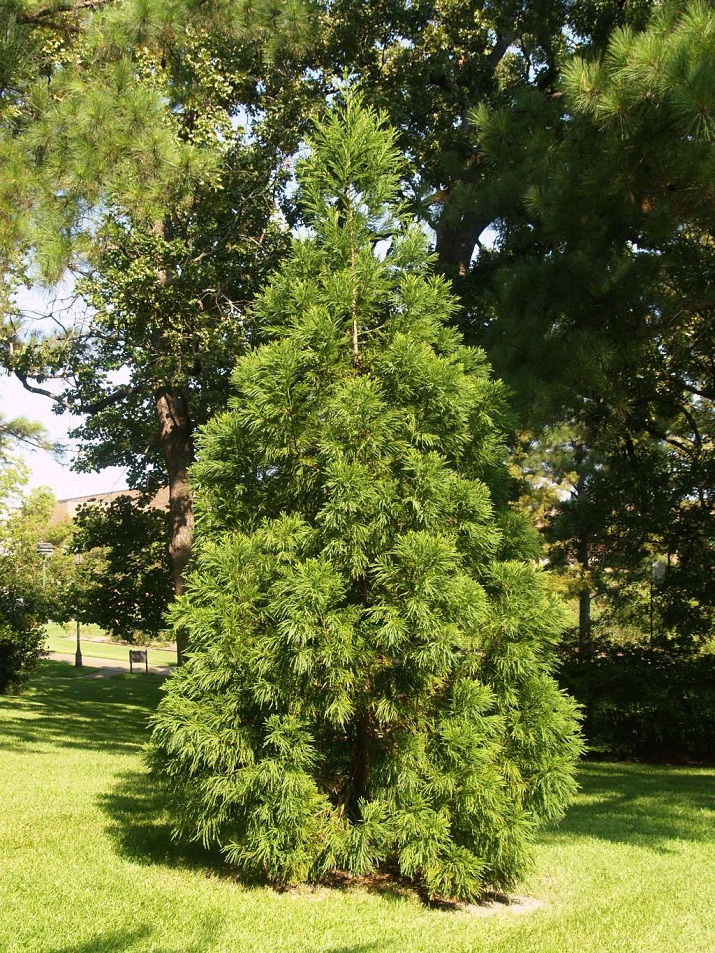
The Japanese cedar or cryptomeria, meaning hidden parts, is a coniferous tree widespread within Japan. It is a handsome tree and only grows prettier with age, with the most striking feature being its pyramidal shape with dense branches, spreading in concentric circles. There are various dwarf cultivars that enhance the aesthetics of the tree even further, and they are used extensively in bonsai.

Scientific Classification
| Kingdom | Plantae |
| Division | Pinophyta |
| Class | Pinopsida |
| Order | Pinales |
| Family | Cupressaceae |
| Subfamily | Taxodioideae |
| Genus | Cryptomeria |
| Scientific Name | Cryptomeria japonica |


Quick Information
| Other Names | Japanese red cedar, sugi (Japanese), Japanese cryptomeria |
| Identification | Size: 230 feet (70 m) Trunk diameter: 13 ft (4 m) Leaves (Needles): Spirally arranged, 0.20-0.39 in (0.5-1 cm) Seeds (Cones): Globular, 0.40-0.79 in (1-2 cm) in diameter, 20-40 scales Bark: Red-brown, exfoliation occurs in vertical strips |
| Tree Type | Evergreen |
| Distribution/Range | Southern & central islands of Japan; also in China, and forestry plantations in the Azores Islands |
| Habitat | Hilly and mountainous forests at 3,280-8,202 feet (1,000-2,500 m) |
| Hardiness Zones | 5-9 |
| Growth Rate | Fast |
| Lifespan | Some Japanese specimens are believed to be over 650 years old, while some trees in China are almost 1,000 |
| Growing Conditions | Winter Conditions: Not resistant to cold and dry winds Summer Conditions: Thrives in warm climate Rainfall: Not more than 47 in (1,200 mm) annually Water Requirement: Medium Soil: Rich, acidic, fertile, moist but well-drained Light Requirement: Full Sun, may withstand partial shade |
| Diseases & Pests | Leaf blight, Phytophthora root disease, Armillaria root rot; insects such as Japanese cedar longhorn beetle |
| Breeding System | Monoecious |
| Propagation | From seeds and cuttings |
| Seedling Development | Germination is relatively easy |
| Wildlife Value | Used as food by moth larvae of the Endoclita genus |
| Cultivars |
|
| Uses | As an ornamental tree, fragrant foliage used to add incense to households, timber and wood insect and weather resistant, and used for making chests, bath tubs, staves, furniture and buildings. |
| IUCN Conservation Status | Near Threatened |


Interesting Facts
- The Japanese cedar was one of the primary causes behind the allergic hay fever outbreak in Japan, besides the Japanese cypress.
- The Japanese cedar is a misnomer as, in fact, it belongs to the cypress family.
- It is recognized as Japan’s national tree.


References