Red spruce trees inhabit eastern North America. Perhaps it’s most well-known use is its effectiveness as a tonewood, which makes it a perfect choice for making guitars and violins. The tree is, however, susceptible to windthrow and acid rain, both of which can damage it rather easily.

Scientific Classification
| Kingdom | Plantae |
| Division | Pinophyta |
| Class | Pinopsida |
| Order | Pinales |
| Family | Pinaceae |
| Genus | Picea |
| Scientific Name | Picea rubens |


Quick Information
| Other Names | Eastern spruce, yellow spruce, West Virginia spruce, he-balsam |
| Tree Type | Evergreen |
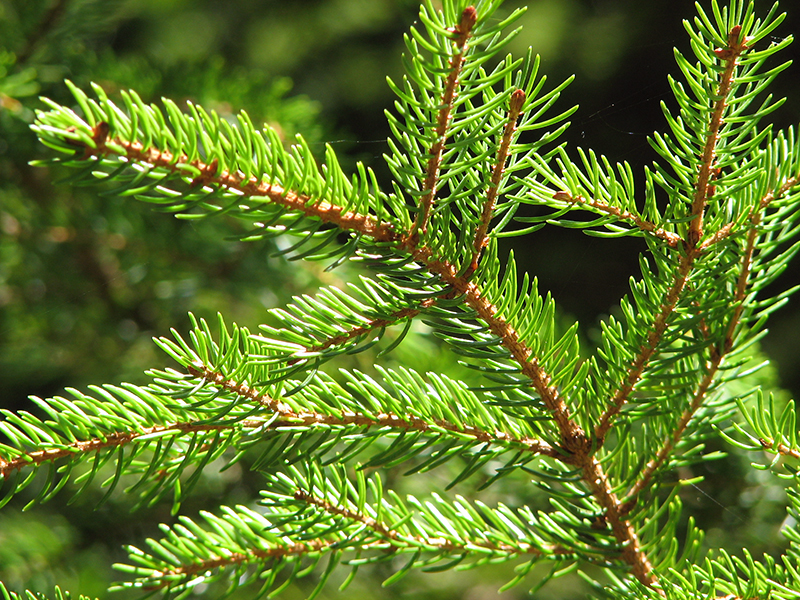
| Identification | Size: 59-131 ft (18-40 m) Trunk Diameter: 2 ft (60 cm) Needles (Leaves): 15⁄32–19⁄32 in (12-15 mm) in length, curved, yellow-green Bark: Grey-brown, red-brown underneath Cones: Ovoid, chestnut-brown, 1.25-2 in (3-5 cm) long with tough scales, hangs from the branches |
| Distribution | Quebec, Ontario, Prince Edward Island, Nova Scotia, and New Brunswick in Canada, Maine, New Hampshire, Vermont, Connecticut, Massachusetts, Pennsylvania, New York, New Jersey, Virginia, West Virginia, Maryland, Tennessee, and North Carolina in the United States, and St. Pierre and Miquelon in France |
| Habitat | Mixed and pure forests, upper montane and subalpine altitudes of 0-6500 ft (2000 m) |
| Hardiness Zones | 3 |
| Growth Rate | Slow to moderate |
| Lifespan | 250-450 years, sometimes more |
| Growing Conditions | Summer Conditions: Requires cool, moist summers Winter Conditions: Cold temperatures Rainfall: Precipitation of around 36-52 inches Soil: Sandy loam, well-drained Light Requirements: Full sun |
| Diseases & Pests | Pests: Spruce budworm, eastern spruce beetle, European spruce sawfly and the yellow-headed spruce sawfly Diseases: Insignificant |
| Reproduction System | Monoecious |
| Propagation | By seeds |
| Seedling Development | Seeds germinate in the spring |
| Wildlife Value | Spruce grouse, mice, voles, crossbills, grosbeaks, bears, porcupines, deer, snowshoe hares, and red squirrels feed on various parts of the tree |
| Uses | Used to make paper pulp, acoustic guitars, violins, spruce gum, construction lumber; decoratively used as Christmas tree; twigs are boiled to make spruce beer, and also spruce pudding |
| IUCN Conservation Status | Least Concern |


Interesting Facts
- The red spruce is the provincial tree of the Canadian maritime province of Nova Scotia.
- It is very similar to the red spruce, and the two species often end up hybridizing when they share a forest.
References:
- https://www.conifers.org/pi/Picea_rubens.php
- https://plants.usda.gov/DocumentLibrary/factsheet/pdf/fs_piru.pdf
- https://www.fs.usda.gov/database/feis/plants/tree/picrub/all.html
- https://plants.ces.ncsu.edu/plants/picea-rubens/
- http://www.adirondackvic.org/Trees-of-the-Adirondacks-Red-Spruce-Picea-rubens.html
- http://dendro.cnre.vt.edu/dendrology/syllabus/factsheet.cfm?ID=137
- https://www.conifers.org/pi/Picea_rubens.php